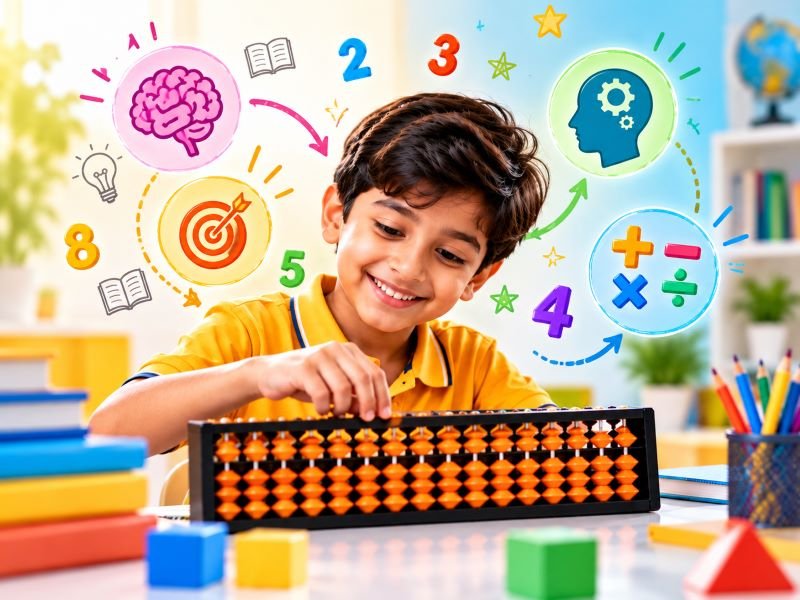
Every parent wants their child to learn confidently, think clearly, and perform well in school. However, children sometimes struggle with concentration, remembering numbers, or solving mathematical problems quickly. Abacus classes for kids offer an engaging way to practise these skills through hands-on activities, visual learning, and regular mental exercises.
An abacus is a traditional counting tool with beads arranged on rods. When children learn to use it, they develop a better understanding of numbers and gradually practise performing calculations mentally.
1. Improves Concentration and Focus
Concentration is an important skill for learning any subject. During abacus training, children move beads according to specific instructions and follow calculation sequences carefully. This requires them to pay attention to each step.
With regular practice, children learn to stay focused on a task for longer periods. These activities can also encourage patience, discipline, and careful observation. Although progress varies from child to child, consistent practice may help children develop better attention habits that support their everyday learning.
2. Strengthens Memory Skills
Abacus learning combines visualisation, listening, and numerical thinking. Initially, children solve calculations by physically moving the beads. As they advance, they practise imagining the abacus in their minds and moving the virtual beads to calculate answers.
This process encourages them to remember bead positions, number combinations, and calculation steps. It also provides practice in working memory, which helps children hold and use information while completing a task.
These memory exercises can support mathematical learning, especially when combined with regular classroom practice and other learning activities.
3. Develops Faster Mental Math Skills
Many children find mathematics difficult because they rely heavily on written calculations. Abacus training introduces them to a visual and practical approach to understanding numbers.
As children become familiar with the abacus, they learn addition, subtraction, and other arithmetic operations using bead movements. With continued practice, they can gradually perform suitable calculations mentally without touching the physical tool.
This method encourages numerical fluency and helps children become more comfortable working with numbers. The speed and accuracy they develop depend on their age, practice, and level of instruction.
4. Builds Confidence and Problem-Solving Ability
Solving a calculation independently can give a child a strong sense of achievement. Abacus classes often include practice exercises, challenges, and progressive learning levels that allow children to recognise their improvement.
As they solve increasingly complex problems, children may become more willing to attempt difficult questions. Learning to break a calculation into smaller steps can also encourage logical thinking and problem-solving habits.
A supportive learning environment is essential. Children should be encouraged to learn at their own pace rather than being pressured to compete with others.
5. Makes Learning Mathematics Enjoyable
Children often learn better when lessons include interactive activities. Colourful beads, practical demonstrations, games, and friendly challenges can make number practice more interesting than repetitive written exercises alone.
Abacus classes combine learning with active participation, helping children develop a more positive attitude towards mathematics. Short, regular practice sessions at home can reinforce classroom learning and help children build consistency.
Conclusion
Abacus classes can provide children with valuable opportunities to practise concentration, working memory, numerical fluency, and problem-solving skills. Through structured lessons and consistent practice, children can become more comfortable with calculations and develop greater confidence in mathematics.
For parents looking to make early maths learning more engaging, an abacus course can be a useful addition to a child’s educational journey. Choosing an age-appropriate programme with experienced instructors and encouraging regular practice can help children make steady progress.