Mathematics is an important part of every child’s education, but many children find calculations difficult or time-consuming. Vedic Mathematics offers an interesting way to make learning maths more engaging through mental calculation techniques, number patterns, and simple shortcuts. With regular practice, children can improve their calculation skills and become more confident when solving mathematical problems.
Vedic Mathematics is a system of calculation popularised through techniques associated with ancient Indian mathematical traditions. It is often taught as a supplementary approach to conventional mathematics, helping children explore different ways to solve problems.
1. Make Addition Faster with Number Splitting
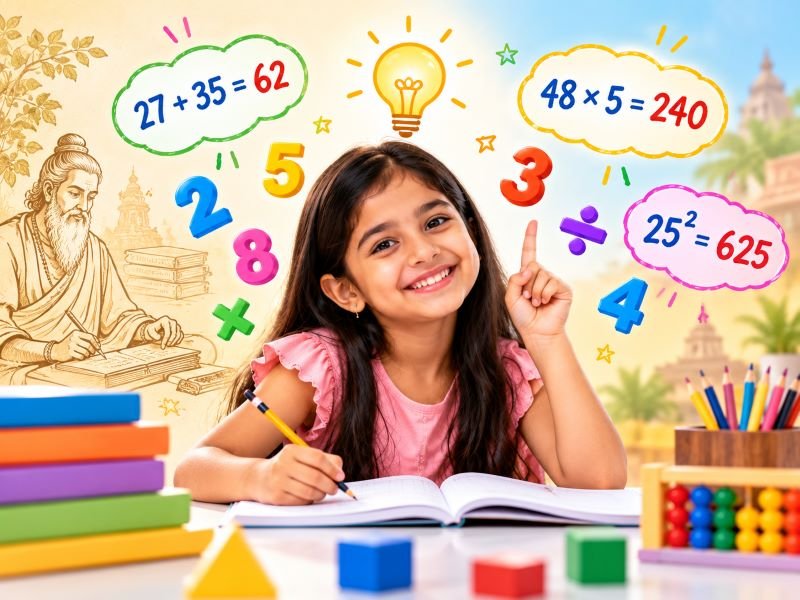
One simple mental maths technique is to break numbers into smaller, easier parts. Instead of adding 27 and 35 all at once, children can split the numbers into tens and ones.
For example:
27 + 35 = 20 + 30 + 7 + 5
= 50 + 12
= 62
Children can also make a round number first. For example, to calculate 38 + 25, add 2 to 38 to make 40, then add the remaining 23.
40 + 23 = 63
This technique encourages flexible thinking and helps children understand how numbers work.
2. Learn Multiplication Shortcuts
Multiplication becomes easier when children recognise number patterns. One useful trick is multiplying numbers by 5.
To multiply an even number by 5, divide it by 2 and then multiply the result by 10.
For example:
48 × 5 = 24 × 10 = 240
For an odd number, the same idea can be applied using a decimal or by splitting the calculation. For example:
35 × 5 = 35 × 10 ÷ 2 = 350 ÷ 2 = 175
These methods help children perform calculations mentally while developing a stronger understanding of multiplication.
3. Square Numbers Ending in 5
A popular Vedic Mathematics technique makes squaring numbers ending in 5 easier.
For example, to calculate 25 × 25:
- Take the first digit, 2.
- Multiply it by the next number, 3.
- Write 25 at the end.
Therefore, 2 × 3 = 6, followed by 25.
The answer is 625.
Similarly, 35 × 35 = 3 × 4, followed by 25 = 1225.
This shortcut can make mental calculations more interesting once children understand the underlying pattern.
4. Develop Better Problem-Solving Skills
Vedic Mathematics encourages children to explore alternative methods rather than depend on only one calculation technique. Learning different approaches can help them recognise patterns, think logically, and select efficient strategies.
However, shortcuts should complement conceptual understanding. Children still need to learn mathematical principles, practise written methods, and understand why an answer is correct.
5. Make Maths Fun Through Regular Practice
Children learn best when lessons are enjoyable and suitable for their age. Parents and teachers can introduce short daily challenges, number games, quizzes, and friendly calculation competitions.
Starting with simple examples and gradually increasing the difficulty helps children practise without feeling overwhelmed. Consistent encouragement is more valuable than pressuring children to calculate quickly.
Conclusion
Vedic Mathematics for kids can make arithmetic more engaging by introducing practical shortcuts, number patterns, and mental calculation techniques. From faster addition to multiplication tricks and squaring numbers ending in 5, these methods offer children new ways to approach maths.
With clear instruction, regular practice, and a strong foundation in basic concepts, children can develop greater numerical fluency and confidence. A supportive learning environment can help turn mathematics from a challenging subject into an enjoyable learning experience.